Gods of Modern Grub Street: Impressions of Contemporary Authors — Edition Insights
Edition facts
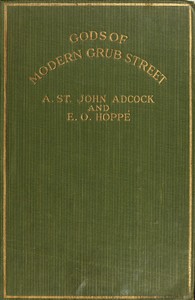
Adcock opens his collection of authorial impressions with a provocative claim: that critics killed Thomas Hardy the novelist, leaving only Hardy the poet to rise from the ashes. This bold assertion sets the tone for a volume that mixes literary criticism with biographical sketch, each chapter accompanied by a photographic portrait by E. O. Hoppé. The book covers thirty-two writers active in the early twentieth century, from Rudyard Kipling to H. G. Wells, and aims to capture not just their published work but the character behind it.
Adcock’s method is impressionistic rather than exhaustive. He draws on personal encounters, letters, and published statements, weaving them into a narrative that often reveals as much about the author’s own tastes as about his subjects. The result is a document of literary London in the 1920s, filtered through a single, opinionated lens.
The Critic as Killer: Hardy’s Novelistic Death
Adcock’s treatment of Thomas Hardy is the most dramatic in the book. He asserts that Hardy was “snuffed out by an article” — a direct challenge to the common wisdom that no author was ever killed by criticism. The evidence, as Adcock presents it, is that Hardy ceased writing novels after the hostile reception of Jude the Obscure and turned to poetry, a genre in which he had been publishing since the 1860s. Adcock frames this as a phoenix-like rebirth, but the emphasis is on loss: the novelist was killed, and only the poet survived.
This opening chapter establishes a pattern of reading authors through their public reception and personal resilience. Adcock does not shy from making judgments, and his willingness to attribute causality to critical opinion gives the book a polemical edge. Readers should note that this is a claim about Hardy’s career, not a documented fact; Adcock presents it as his interpretation, supported by the timing of Hardy’s shift in genre.
Reticence and Autobiography: The Case of Stephen McKenna
In the chapter on Stephen McKenna, Adcock turns to the problem of autobiographical truth. He recounts a theory from Keble Howard that autobiographies should be written in three volumes — the first before thirty, the second at fifty, the third near the end — to avoid the distortions of memory. Adcock endorses this view, noting that older memoirists often “make tragedies of what then seemed comedies, and comedies of what seemed tragedies.”
McKenna’s own While I Remember, published when he was thirty-three, is held up as a partial success. Adcock praises its “devastating wit and epigrammatic satire” regarding public life but observes that McKenna is “almost as reticent in talking of himself as of others.” The chapter includes a rare quoted passage where McKenna confesses his incompetence as a teacher, blushing at the lessons he gave. This tension between candor and discretion becomes a recurring theme: how much of a writer’s private self can be known through their published work?
Portraits and Impressions: The Role of Photography
Each profile in Gods of Modern Grub Street is prefaced by a photographic portrait by E. O. Hoppé, a noted photographer of the era. These images are not mere illustrations; they are part of the book’s claim to offer an “impression” of each author. Adcock’s text often describes his subjects’ appearance or manner, as when he notes Hardy’s “phoenix-like” transformation or McKenna’s gentlemanly reserve. The photographs ground these verbal sketches in a visual reality, suggesting that the author’s character can be read in their face.
The combination of word and image was a deliberate choice. Hoppé’s portraits were widely admired for their psychological depth, and Adcock’s prose aims for a similar effect — to capture the essence of a writer in a few pages. Readers should consider how the photographs interact with the text: do they confirm Adcock’s impressions, or do they offer a counterpoint? The book’s structure invites this kind of cross-reading, making it as much a gallery as a collection of essays.
Adcock’s Gods of Modern Grub Street is best read as a series of encounters rather than a definitive critical history. The author’s voice is strong, his judgments clear, and his willingness to speculate — as with Hardy’s novelistic death — gives the book a conversational energy. The portraits by Hoppé add a visual dimension that rewards attention. For readers interested in early twentieth-century literary culture, this volume offers a snapshot of how one contemporary saw his peers, with all the biases and insights that implies.