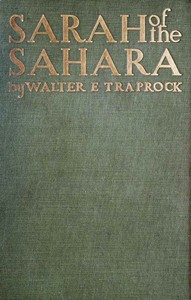
Sarah of the Sahara: A Romance of Nomads Land — Story, Setting & Ideas
Edition facts
From its opening line—a string of mock-Arabic exclamations—Sarah of the Sahara announces itself as a burlesque of desert romance. The narrator, Dr. Walter E. Traprock, introduces himself as “El Sheik Traprock, Dhub of t…” and describes his own appearance as “like a covered wagon.” The book’s front matter lists a cast of “Super-Stars” from a fictional film, and chapter titles such as “Love at First Sight” and “Death in the Desert” signal a knowing parody of adventure formulas. The excerpts show a narrator who treats the desert as a stage for his own heroics, punctuating action with geometry lessons and self-conscious literary flourishes.
The Narrator’s Self-Conscious Voice
Dr. Traprock’s narration is the book’s most distinctive feature. He addresses Sarah in apostrophes that pile up similes: “whom I have hymned in terms of pomegranates, peacock’s-eyes and alabaster columns.” He describes himself in the third person, as “El Sheik Traprock,” and his followers cry out “Bishmillah!” and “Wahully!” in a parody of Orientalist clichés. The narrator’s voice is grandiose and self-mocking, never letting the reader forget that this is a performance. Even in moments of danger, he pauses for literary effect: “How I cursed the desert for its magnificent distances.” This constant self-awareness makes the book less a straightforward adventure than a commentary on the genre.
Geometry as a Plot Device
In the rescue sequence, Traprock halts his band to draw “an accurate diagram on the desert, which is ideally adapted for geometric study.” He recalls that “the square of the hypotenuse is equal to the sum of the squares of the other two sides” and uses this to calculate a shortcut, leaping into the saddle with a cry of “Q.E.D.” The episode is played for laughs—he prays “Heaven Euclid was right”—but it also shows how the book uses intellectual posturing as a comic counterpoint to desert action. The narrator’s reliance on Euclidean logic in a setting of shifting sands and tribal warfare underscores the absurdity of applying rational systems to chaotic adventure.
The Film-Framing and Visual Tableaux
The book is presented as the basis for a “Super-Feature Film” by the All-for-Art Production Co. of Derby, Conn., with a frontispiece listing “Super-Stars” and chapter illustrations described as photographs from the film. This framing turns the narrative into a series of set pieces. The rescue scene, for example, is described in visual terms: “The sun had cleared the horizon and struck brightly on our flowing cloaks.” A character named Swank rides off to take a photograph, and the narrator is compared to “a swift-running tide-race foaming over a hidden reef.” These moments suggest that the story is less concerned with realism than with creating striking images suitable for a silent film.
Movement Between Desert and Domesticity
The excerpts show a constant oscillation between the exotic desert and the familiar, often British, domestic sphere. Lord Horace Wimpole, upon suspecting attack, forms his group into “a British square,” a military formation from colonial warfare. The narrator’s followers are “picked nomads,” but they speak in pseudo-Arabic exclamations that are clearly invented. The desert itself is described in terms of a stage: “the desert for its magnificent distances.” This movement between the foreign and the familiar creates a comic tension, as the characters impose British order on a landscape that resists it. The book’s subtitle, “A Romance of Nomads Land,” hints at a playful treatment of nomadic life.
Readers should approach Sarah of the Sahara not as a genuine adventure but as a parody that winks at its own conventions. The narrator’s exaggerated voice, the geometric interlude, and the film-production framing all reward attention to detail. The excerpts offer only a partial view; the full book likely extends these comic strategies across a series of improbable rescues and romantic entanglements. For those who enjoy literary burlesque, this is a desert romance that never takes itself seriously.