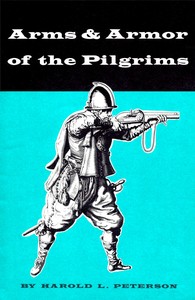
Arms and Armor of the Pilgrims, 1620-1692 by Harold L. Peterson

(4 User reviews)   883
Peterson, Harold L. (Harold Leslie), 1922-1978 Peterson, Harold L. (Harold Leslie), 1922-1978
English
Ever wonder what it really felt like to be a Pilgrim? Forget the buckled hats and somber portraits—what about the muskets, swords, and armor? Harold L. Peterson's book pulls back the curtain on the 17th century in a way you've never seen. He shows us that the Mayflower passengers and their descendants weren't just peaceful farmers; they were people who lived in a world of constant, tangible danger. This book answers the questions you didn't know you had: What did their weapons look like? How did they work? And how did this gear shape their daily survival and the conflicts that built a new world? It turns history from a story in a book into something you can almost hold in your hands.
Share

Read "Arms and Armor of the Pilgrims, 1620-1692 by Harold L. Peterson" Online

This book is available in the public domain. Start reading the digital edition below.

START READING FULL BOOK
Instant Access    Mobile Friendly

Book Preview

A short preview of the book’s content is shown below to give you an idea of its style and themes.

Illustrations have been moved so they do not break up paragraphs. Old or antiquated spellings have been preserved. Typographical and punctuation errors have been silently corrected. [Illustration] Fotoset and Lithographed by COLORTONE PRESS, Washington 9, D. C. ARMS AND ARMOR OF THE PILGRIMS 1620-1692 by Harold L. Peterson [Illustration: Patrero or “murderer”] Published by Plimoth Plantation, Inc. and the Pilgrim Society, Plymouth 1957 [Illustration: _A seventeenth century musketeer ready to fire his matchlock. From Jacques de Gheyn_, Maniement d’Armes, _1608_.] The average colonist landing on the wild shores of North America in the early 1600’s set great store by his arms and armor. The Pilgrims were no exception. They were strangers in a vast and largely unknown land, inhabited by wild beasts and peopled by savages who were frequently hostile. Greatly outnumbered by known enemies and possibly facing dangers of which they were not yet aware, these Englishmen placed their main hope for survival on the possession of superior weapons and protective armor. On the more peaceful side, their firearms were also valuable, for they provided fresh meat for the table and furs for sale back home. Because the colonist was so dependent on his arms he soon learned to select the most efficient kinds that he could obtain. In so doing he pushed the evolution of military materiel far ahead of contemporary Europe and developed a high degree of skill, particularly in the use of firearms. The military supplies which the Pilgrims brought with them may be divided into three major categories: defensive armor, edged weapons, and projectile weapons. A completely armed man, especially in the first years, was usually equipped with one or more articles from each of the three groups, usually a helmet and corselet, a sword, and a musket. ARMOR Of all the pieces of defensive armor, the most popular was the helmet. Almost everyone wore one when he prepared for trouble. Most of those worn at Plymouth were undoubtedly open helmets which left the face uncovered, although it is possible that a few completely closed helmets were also used. These open helmets were of three principal types: the cabasset, the morion, and the burgonet. The cabasset was a simple, narrow brimmed helmet with a keeled bowl and a tiny apical peak pointing to the rear. The morion had a larger crescentic brim pointed at the front and back and a high comb along the center-line of the bowl. The better specimens of both these helmets were forged from a single billet of steel, and both were very efficient defenses. The curving lines of the bowls caused most blows to glance off without imparting their full impact, and the comb of the morion presented an extra buffer of metal through which a sword would have to cut before it reached the bowl. Inside each helmet was a quilted lining held in place by a row of rivets around the base of the crown which acted much like the modern helmet liner in holding the steel shell away from the wearer’s head. [Illustration: _Cabasset._] [Illustration: _Morion._] The burgonet was a slightly more complicated helmet than the morion or cabasset, and it was made in a variety of styles. Basically, it was an open-faced helmet which covered more of the head than the other two. Usually it had a peak or umbril somewhat like the visor of a modern cap over the eyes, a comb on the bowl, and movable plates to protect the cheeks and ears. Often there was a defense for the face in the form of a single adjustable bar which passed through a hole...

This is a limited preview. Download the book to read the full content.

This isn't a novel with a plot, but it tells a gripping story nonetheless. Arms and Armor of the Pilgrims is a detailed look at the tools of survival and conflict used by the English colonists in New England from their arrival through the end of the 17th century. Peterson systematically explores everything from the common matchlock musket to breastplates, swords, and even the often-overlooked equipment like powder horns and bullet molds. He connects each piece to its practical use, showing how technology dictated tactics in battles like the Pequot War and King Philip's War, and how everyday life required constant readiness.

Why You Should Read It

This book changes your perspective. It makes the Pilgrims and Puritans feel less like distant figures from a painting and more like real, complicated people facing immense hardship. You gain a concrete understanding of their world—the weight of a musket, the limitation of its range, the sheer labor of maintaining armor. Peterson's research is deep, but he presents it with a clear passion for the subject. You come away feeling like you've handled the artifacts yourself, and that tangible connection to the past is incredibly powerful.

Final Verdict

Perfect for history buffs, reenactors, or anyone who loves American history but wants to move beyond the political narratives. If you've ever visited Plimoth Patuxet or a living history museum and wondered, 'But how did that *actually* work?' this is your book. It's a niche subject treated with great care, offering a unique and surprisingly engaging lens on a familiar chapter of our past.


🔓 Legacy Content

There are no legal restrictions on this material. You are welcome to share this with anyone.

Lucas Nguyen
4 months ago

This came highly recommended and the plot twists are genuinely surprising without feeling cheap or forced. Time very well spent.

Aiden Wright
5 months ago

In my opinion, the atmosphere created by the descriptive language is totally immersive. I finished this feeling genuinely satisfied.

Liam Brown
5 months ago

I discovered this unexpectedly and it serves as a poignant reminder of the human condition. I will be reading more from this author.

Paul Robinson
3 months ago

I almost skipped this one, yet it serves as a poignant reminder of the human condition. I couldn't put it down until the very end.

4.5
4.5 out of 5 (4 User reviews )

Add a Review

Your Rating *
There are no comments for this eBook.
You must log in to post a comment.
Log in

Related eBooks