
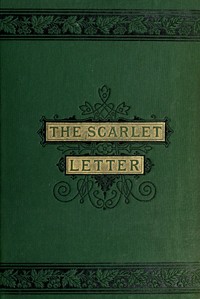
The Scarlet Letter by Nathaniel Hawthorne

(5 User reviews)   690
Hawthorne, Nathaniel, 1804-1864 Hawthorne, Nathaniel, 1804-1864
English
Picture this: a small, strict Puritan town in the 1600s. A young woman named Hester Prynne is forced to wear a bright red 'A' on her dress as punishment for having a child out of wedlock. But here's the thing—she refuses to name the father. The real story isn't just about her public shame; it's the slow, quiet torment of the secret man who watches her suffer every day, eaten alive by his own guilt. It's a story about the weight of a secret versus the pain of a punishment, and it asks a tough question: which is worse?
Share

Read "The Scarlet Letter by Nathaniel Hawthorne" Online

This book is available in the public domain. Start reading the digital edition below.

START READING FULL BOOK
Instant Access    Mobile Friendly

Book Preview

A short preview of the book’s content is shown below to give you an idea of its style and themes.

offering proofs of the authenticity of a narrative therein contained. This, in fact—a desire to put myself in my true position as editor, or very little more, of the most prolix among the tales that make up my volume—this, and no other, is my true reason for assuming a personal relation with the public. In accomplishing the main purpose, it has appeared allowable, by a few extra touches, to give a faint representation of a mode of life not heretofore described, together with some of the characters that move in it, among whom the author happened to make one. In my native town of Salem, at the head of what, half a century ago, in the days of old King Derby, was a bustling wharf—but which is now burdened with decayed wooden warehouses, and exhibits few or no symptoms of commercial life; except, perhaps, a bark or brig, half-way down its melancholy length, discharging hides; or, nearer at hand, a Nova Scotia schooner, pitching out her cargo of firewood—at the head, I say, of this dilapidated wharf, which the tide often overflows, and along which, at the base and in the rear of the row of buildings, the track of many languid years is seen in a border of unthrifty grass—here, with a view from its front windows adown this not very enlivening prospect, and thence across the harbour, stands a spacious edifice of brick. From the loftiest point of its roof, during precisely three and a half hours of each forenoon, floats or droops, in breeze or calm, the banner of the republic; but with the thirteen stripes turned vertically, instead of horizontally, and thus indicating that a civil, and not a military, post of Uncle Sam’s government is here established. Its front is ornamented with a portico of half-a-dozen wooden pillars, supporting a balcony, beneath which a flight of wide granite steps descends towards the street. Over the entrance hovers an enormous specimen of the American eagle, with outspread wings, a shield before her breast, and, if I recollect aright, a bunch of intermingled thunderbolts and barbed arrows in each claw. With the customary infirmity of temper that characterizes this unhappy fowl, she appears by the fierceness of her beak and eye, and the general truculency of her attitude, to threaten mischief to the inoffensive community; and especially to warn all citizens careful of their safety against intruding on the premises which she overshadows with her wings. Nevertheless, vixenly as she looks, many people are seeking at this very moment to shelter themselves under the wing of the federal eagle; imagining, I presume, that her bosom has all the softness and snugness of an eiderdown pillow. But she has no great tenderness even in her best of moods, and, sooner or later—oftener soon than late—is apt to fling off her nestlings with a scratch of her claw, a dab of her beak, or a rankling wound from her barbed arrows. The pavement round about the above-described edifice—which we may as well name at once as the Custom-House of the port—has grass enough growing in its chinks to show that it has not, of late days, been worn by any multitudinous resort of business. In some months of the year, however, there often chances a forenoon when affairs move onward with a livelier tread. Such occasions might remind the elderly citizen of that period, before the last war with England, when Salem was a port by itself; not scorned, as she is now, by her own merchants and ship-owners, who permit her wharves to crumble to ruin while their...

This is a limited preview. Download the book to read the full content.

The Story

The Scarlet Letter is set in 17th-century Boston. Hester Prynne is publicly shamed for adultery and must wear a scarlet 'A' for the rest of her life. She raises her daughter, Pearl, alone on the outskirts of town. The mystery at the heart of the book is the identity of Pearl's father. We watch as Reverend Arthur Dimmesdale, a beloved but sickly minister, slowly wastes away from a hidden guilt only he and Hester share. Meanwhile, Hester's long-lost husband, Roger Chillingworth, arrives and, suspecting the truth, dedicates himself to psychologically torturing Dimmesdale.

Why You Should Read It

Forget dusty history—this book feels surprisingly modern. It’s less about sin and more about the different ways people handle shame, secrets, and the judgment of others. Hester's quiet strength as she rebuilds her life is incredible. But for me, the most gripping part is watching Dimmesdale. His private agony is so much more devastating than Hester's public punishment. Hawthorne makes you feel the physical and mental cost of living a lie. It’s a powerful look at how society brands people and how they choose to wear that brand.

Final Verdict

This is a classic for a reason. It's perfect for anyone who loves a deep, psychological character study wrapped in a historical drama. If you enjoy stories about secrets, resilience, and the complex morals of a community, you'll be hooked. Just be ready for some beautifully dense, old-fashioned prose—it's worth slowing down for.


🔓 Legacy Content

You are viewing a work that belongs to the global public domain. Distribute this work to help spread literacy.

Susan Smith
5 months ago

After hearing about this multiple times, the depth of research presented here is truly commendable. A true masterpiece of its kind.

Mark Walker
5 months ago

Once I began reading, the attention to historical detail adds a layer of realism that is rare. I would gladly recommend this to others.

Amanda King
4 months ago

As part of my coursework, the author anticipates common questions and addresses them well. I have no regrets downloading this.

Sarah Allen
1 month ago

I didn't expect much, but the storytelling feels authentic and emotionally grounded. This felt rewarding to read.

William Allen
5 months ago

I had low expectations initially, however the tone remains consistent and professional throughout. This made complex ideas feel approachable.


4.5
4.5 out of 5 (5 User reviews )

Add a Review

Your Rating *
There are no comments for this eBook.
You must log in to post a comment.
Log in

Related eBooks