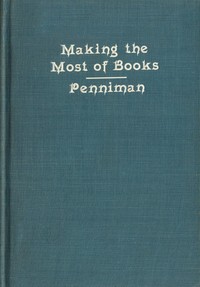
Books and how to make the most of them by James Hosmer Penniman

(4 User reviews)   925
Penniman, James Hosmer, 1860-1931 Penniman, James Hosmer, 1860-1931
English
Ever feel like you're just collecting books instead of really reading them? That's exactly what James Hosmer Penniman tackles in this 1920s gem. It's not about what to read, but how to read—how to actually absorb ideas, remember them, and make them part of your thinking. This book argues that a well-read mind isn't built by speed or volume, but by careful attention. It's a surprisingly modern wake-up call from a century ago, challenging our casual relationship with books and offering a blueprint for a deeper, more meaningful one. If your shelves are full but your reading feels empty, this might be the guide you need.
Share

Read "Books and how to make the most of them by James Hosmer Penniman" Online

This book is available in the public domain. Start reading the digital edition below.

START READING FULL BOOK
Instant Access    Mobile Friendly

Book Preview

A short preview of the book’s content is shown below to give you an idea of its style and themes.

white page should bring before our minds the most beautiful images. More remarkable than the telegraph or the telephone, a book not only annihilates space but time, and carries the voice of David or Homer across the seas of the ages. The miracle of the widow’s cruse finds its literal realization in a book. We may take all we can from it but there is just as much left for others with the sole limitation that he gets the most from books who has the most knowledge; to him that hath is given. No other property is so peculiarly our own as our intellectual possessions. They are always with us; no reversal of fortune can deprive us of them. If we share our knowledge with another we still have it, and perhaps in a more orderly and useful form as the result of contact with a different mind, and the belief in the immortality of the soul makes us sure that our mental acquisitions are taken with us beyond the grave. Education and culture would be of small value if they were to be terminated by the expiration of a few short years of life. Books are the only work of man that may be said to be omniscient. They are the stored-up memory of the race. As all our experience of life would vanish without memory, so all accurate knowledge of mankind would evaporate without books and we should have nothing to depend upon but tradition. Without books we should know nothing of the workings of the mighty minds of Homer, Virgil, Dante, Shakespeare or Milton. Without them Caesar, Napoleon and Washington would be traditions. We can get but an imperfect idea of the history of our country except from books. Books alone make books possible, and nothing is more rare than a book which does not depend for its material on other books. Books stereotype and petrify language so that while the spoken word is volatile and changeable we find in books the very words in which we took delight years ago. We may cause to pass through our minds the same thoughts in absolutely the same language that interested Dr. Johnson or Milton; we may even follow out the mental processes of Plato or Aristotle, and see what they enjoyed and note what they thought. Books intensify thought; a book is better than conversation in that it may be brooded over, revised, extended, polished and continued from time to time, but it cannot answer questions except those anticipated by its author. A writer will put into a book thoughts that he would not or could not express in conversation, and through his books we may know intimately a man who was known only superficially by his most familiar contemporaries. Books not only acquaint us with the thoughts of the great men of the past but they enable us to make permanent our own thoughts, so that if our ideas are worthy of being perpetuated those who live centuries hence may be as familiar with our minds as we are with the minds of Milton or Dante. A book enables the thought of one man to reach all other inquiring men in ages to come. Men of whom their world was not worthy have gained late recognition through their books; men whose minds were far in advance of their time have handed down their thoughts in books which have at last found appreciative readers. The printing press has multiplied enormously our means of giving currency to ideas, but thought is no more powerful now than in the time...

This is a limited preview. Download the book to read the full content.

Let's be honest—most book advice tells you what to read. This book is different. Written in 1922, James Hosmer Penniman's Books and how to make the most of them skips the reading lists and gets straight to the core question: How do we actually learn from a book?

The Story

There's no plot here, but there is a clear mission. Penniman acts as a friendly coach, walking you through the practical steps of engaged reading. He breaks down how to choose a book with purpose, how to take notes that stick, and how to connect new ideas to what you already know. He champions active reading over passive consumption, arguing that marking up a book and wrestling with its arguments is how true understanding happens.

Why You Should Read It

What struck me is how current it feels. Penniman was writing long before digital distractions, but his advice tackles the same problem we have today: shallow engagement. Reading his methods—like his system for marginal notes—feels like getting permission to have a real conversation with the text. It transformed how I approach non-fiction. This isn't about reading faster; it's about reading smarter and building a personal library of knowledge, not just a collection of spines.

Final Verdict

Perfect for students, lifelong learners, or any serious reader who feels their highlighters and good intentions aren't quite enough. If you want your reading to leave a permanent mark on your mind, this short, direct guide from the past offers timeless tools. It’s a quiet masterclass in treating books as partners in thought, not just products to consume.


🔓 Public Domain Content

This digital edition is based on a public domain text. Use this text in your own projects freely.

Barbara Hernandez
1 month ago

Simply put, the content encourages further exploration of the subject. Highly recommended for everyone.

Christopher Clark
3 months ago

From a reader’s standpoint, the content encourages further exploration of the subject. I finished this feeling genuinely satisfied.

Brian Robinson
2 months ago

If you enjoy this genre, the author anticipates common questions and addresses them well. Time very well spent.

Paul Mitchell
4 months ago

Out of sheer curiosity, the emotional weight of the story is balanced perfectly with moments of levity. It exceeded all my expectations.
4
4 out of 5 (4 User reviews )

Add a Review

Your Rating *
There are no comments for this eBook.
You must log in to post a comment.
Log in

Related eBooks