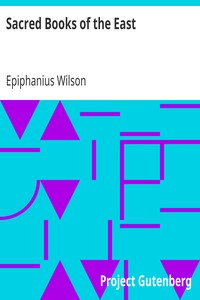
Sacred Books of the East by Epiphanius Wilson et al.

(4 User reviews)   1020
English
Ever wonder what's actually inside the world's great spiritual texts, but felt intimidated by the sheer volume? That's the exact question that led to 'Sacred Books of the East.' This isn't a single story; it's a massive collection of foundational writings from across Asia, compiled for curious Western readers over a century ago. Think of it as a time capsule of human belief. The real 'mystery' is discovering the surprising connections and profound differences between traditions like Hinduism, Buddhism, Zoroastrianism, and Islam, all gathered in one place. It's like a grand, spiritual buffet—you can sample a bit of everything.
Share

Read "Sacred Books of the East by Epiphanius Wilson et al." Online

This book is available in the public domain. Start reading the digital edition below.

START READING FULL BOOK
Instant Access    Mobile Friendly

Book Preview

A short preview of the book’s content is shown below to give you an idea of its style and themes.

elemental religious conceptions and are full of the imagery of nature. It would be absurd to deny to very many of them the possession of the truest poetic inspiration. The scenery of the Himalayas, ice and snow, storm and tempest, lend their majesty to the strains of the Vedic poet. He describes the storm sweeping over the white-crested mountains till the earth, like a hoary king, trembles with fear. The Maruts, or storm-gods, are terrible, glorious, musical, riding on strong-hoofed, never-wearying steeds. There is something Homeric, Pindaric in these epithets. Yet Soma and Rudra are addressed, though they wield sharp weapons; and sharp bolts, i.e., those of the lightning, are spoken of as kind friends. "Deliver us," says the poet, "from the snare of Varuna, and guard us, as kind-hearted gods." One of the most remarkable of these hymns is that addressed to the Unknown God. The poet says: "In the beginning there arose the Golden Child. As soon as he was born he alone was the lord of all that is. He established the earth and this heaven." The hymn consists of ten stanzas, in which the Deity is celebrated as the maker of the snowy mountains, the sea and the distant river, who made fast the awful heaven, He who alone is God above all gods, before whom heaven and earth stand trembling in their mind. Each stanza concludes with the refrain, "Who is the God to whom we shall offer sacrifice?" We have in this hymn a most sublime conception of the Supreme Being, and while there are many Vedic hymns whose tone is pantheistic and seems to imply that the wild forces of nature are Gods who rule the world, this hymn to the Unknown God is as purely monotheistic as a psalm of David, and shows a spirit of religious awe as profound as any we find in the Hebrew Scriptures. It is very difficult to arrive at the true date of the Vedas. The word Veda means knowledge, and is applied to unwritten literature. The Vedas are therefore the oldest Sanscrit writings which exist, and stand in the same class with regard to Hindoo literature as Homer does with regard to Greek literature. Probably the earliest Vedas were recited a thousand years before Christ, while the more recent of the hymns date about five hundred before Christ. We must therefore consider them to be the most primitive form of Aryan poetry in existence. There is in the West a misunderstanding as to the exact meaning of "Vedic" and "Sanscrit"; for the latter is often used as if it were synonymous with Indian; whereas, only the later Indian literature can be classed under that head, and "Vedic" is often used to indicate only the Vedic Hymns, whereas it really denotes Hymns, Bráhmanas, Upanishads, and Sutras; in fact, all literature which orthodox Hindoos regard as sacred. The correct distinction then between the Vedic and the Sanscrit writings is that of holy writ and profane literature. E.W. VEDIC HYMNS TO THE UNKNOWN GOD In the beginning there arose the Golden Child. As soon as born, he alone was the lord of all that is. He established the earth and this heaven:--Who is the God to whom we shall offer sacrifice? He who gives breath, he who gives strength, whose command all the bright gods revere, whose shadow is immortality, whose shadow is death:--Who is the God to whom we shall offer sacrifice? He who through his might became the sole king of the breathing and twinkling world, who governs all this, man and beast:--Who is the God...

This is a limited preview. Download the book to read the full content.

Don't expect a novel with a plot. Sacred Books of the East is a 50-volume project from the late 1800s, edited by scholars like Max Müller and Epiphanius Wilson. Their goal was monumental: to translate and publish the core scriptures of Eastern religions for an English-speaking audience. This collection includes everything from the poetic hymns of the Rig-Veda and the philosophical dialogues of the Upanishads to the teachings of the Buddha and the sayings of Confucius.

Why You Should Read It

Reading this is a unique experience. It’s not about rushing through; it’s about dipping in and out. You might read a Buddhist sutra on compassion one night and a passage from the Quran the next. What struck me was how these ancient voices grapple with the same big questions we do: life, death, morality, and our place in the universe. Seeing the different answers side-by-side is genuinely eye-opening. The language is sometimes old-fashioned, but that just adds to the feeling of uncovering something timeless.

Final Verdict

This is for the patient and curious reader. Perfect for anyone interested in world religions, comparative mythology, or the history of ideas. It's not light bedtime reading, but an incredibly rewarding reference. Think of it less as a book to finish and more as a library to explore for a lifetime. If you've ever been curious about the source material behind so many of the world's beliefs, this is your direct line to it.


🔖 Copyright Status

This book is widely considered to be in the public domain. You are welcome to share this with anyone.

Brian Rodriguez
5 months ago

Frrom a technical perspective, the interplay between the protagonists drives the story forward beautifully. I learned so much from this.

Donna Jones
5 months ago

I was searching for something reliable and the examples add real-world context to abstract ideas. It is definitely a 5-star read from me.

Andrew Rodriguez
2 months ago

During my studies, I found that the plot twists are genuinely surprising without feeling cheap or forced. A perfect companion for a quiet weekend.

Aiden Wilson
5 months ago

I went into this with no expectations and the narrative structure is incredibly compellng and well-thought-out. This left a lasting impression on me.

5
5 out of 5 (4 User reviews )

Add a Review

Your Rating *
There are no comments for this eBook.
You must log in to post a comment.
Log in

Related eBooks