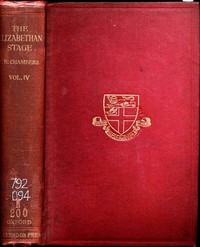
The Elizabethan Stage, Vol. 4 by E. K. Chambers

(4 User reviews)   973
Chambers, E. K. (Edmund Kerchever), 1866-1954 Chambers, E. K. (Edmund Kerchever), 1866-1954
English
Ever wonder what really happened behind the curtains of Shakespeare's world? This isn't about the plays you know, but the messy, dangerous, and wildly creative machine that made them possible. It's a deep look at the people who built the stages, the companies who fought to perform, and the government officials who tried to shut it all down. If you think theater history is dry, this book will change your mind. It's a backstage pass to the drama behind the drama.
Share

Read "The Elizabethan Stage, Vol. 4 by E. K. Chambers" Online

This book is available in the public domain. Start reading the digital edition below.

START READING FULL BOOK
Instant Access    Mobile Friendly

Book Preview

A short preview of the book’s content is shown below to give you an idea of its style and themes.

third group a few which might alternatively have been brought into ch. xxiii under the name of a part-author or describer.] A. PLAYS _An Alarum for London > 1600_ _S. R._ 1600, May 27. ‘Allarum to London’ is included in a memorandum of ‘my lord chamberlens menns plaies Entred’ and noted as entered on this day to J. Roberts (Arber, iii. 37). 1600, May 29. ‘The Allarum to London, provided that yt be not printed without further Aucthoritie.’ _John Roberts_ (Arber, iii. 161). 1602. A Larum for London, or The Siedge of Antwerpe. With the ventrous actes and valorous deeds of the lame Soldier. As it hath been playde by the right Honorable the Lord Chamberlaine his Seruants. _For William Ferbrand._ [Prologue and Epilogue.] _Editions_ by R. Simpson (1872), J. S. Farmer (1912, _T.F.T._), and W. W. Greg (1913, _M.S.R._). The play has been ascribed to Shakespeare by Collier, to Shakespeare and Marston by Simpson, and to Lodge by Fleay, _Shakespeare_, 291, but no serious case has been made out for any of these claims. Bullen, _Marlowe_, 1, lxxiv, says that Collier had a copy with doggerel rhymes on the t.p. including the line, Our famous Marloe had in this a hand, which Bullen calls ‘a very ridiculous piece of forgery’. _Albion Knight > 1566_ _S. R._ 1565–6. ‘A play intituled a merye playe bothe pytthy and pleasaunt of Albyon knyghte.’ _Thomas Colwell_ (Arber, i. 295). Fragment in Devonshire collection. [The t.p. is lost, but the seventeenth-century play lists (Greg, _Masques_, xlvii) include an interlude called _Albion_. A fragment on Temperance and Humility, conjecturally assigned by Collier, i. 284, to the same play, is of earlier printing by thirty years or so (_M.S.C._ i. 243).] _Editions_ by J. P. Collier (1844, _Sh. Soc. Papers_, i. 55) and W. W. Greg (1910, _M. S. C._ i. 229).--_Dissertations_: M. H. Dodds, _The Date of A. K._ (1913, 3 _Library_, iv. 157); G. A. Jones, _The Political Significance of A. K._ (1918, _J. G. P._ xvii. 267). Collier suggests that this was the play disliked at court on 31 Dec. 1559, but, as Fleay, 66, points out, that would hardly have been licensed for printing. Dodds thinks it motived by the Pilgrimage of Grace (1536–7) and written shortly after. _Alice and Alexis_ A fragment (to iii. 1) of a play on the loves of Alice and Alexis, thwarted by Tanto, with an argument of the whole, is in _Douce MS._ 171 (_Bodl._ 21745), f. 48^v. The date ‘1604’ is scribbled amongst the pages. The manuscript also contains sixteenth-century accounts. There seems nothing to connect this with Massinger’s _Alexius, or the Chaste Lover_, licensed by Herbert on 25 Sept. 1639 and apparently included in Warburton’s list of burnt plays (3 _Library_, ii. 232, 249). _Alphonsus, Emperor of Germany > 1636_ _S. R._ 1653, Sept. 9. ‘A play called Alphonso, Emperor of Germany, by John Poole.’ _H. Moseley_ (Eyre, i. 428). 1654. The Tragedy of Alphonsus Emperour of Germany. As it hath been very often Acted (with great applause) at the Privat house in Black-Friers by his late Maiesties Servants. By George Chapman Gent. _For Humphrey Moseley._ [Epistle to the Reader. The B.M. copy of the play is dated ‘Novemb. 29, 1653’.] _Editions_ by K. Elze (1867) and H. F. Schwarz (1913), and in collections of Chapman (q.v.). _Alphonsus_ may reasonably be identified with the _Alfonso_ given before the Queen and the Elector Palatine at the Blackfriars on 5 May 1636 (Cunningham, xxiv). The ascription on the title-page to Chapman is repeated therefrom by Langbaine who rejects that of Kirkman in 1661 and 1671 (Greg,...

This is a limited preview. Download the book to read the full content.

Forget the polished performances. The Elizabethan Stage, Vol. 4 pulls you into the gritty reality of putting on a show in the 1500s and 1600s. This isn't a story with a single plot, but a collection of true stories about an entire industry being born.

The Story

Think of it as a documentary in book form. E.K. Chambers pieces together the lives of the acting troupes, from famous names to forgotten players. He shows us the constant battles they faced: finding a place to perform, dealing with angry city officials and plague closures, and navigating the tricky politics of royal patronage. The book maps out the physical playhouses, follows the money, and tracks how plays got from the writer's desk to the stage. The central tension is between explosive creative energy and a society that was deeply suspicious of it.

Why You Should Read It

This volume makes the past feel immediate. You get a real sense of the hustle and risk involved. It's fascinating to see how familiar struggles—art versus commerce, innovation versus tradition—played out 400 years ago. Chambers connects the dots between laws, architecture, and social attitudes to show why this era produced such unforgettable work. It adds incredible depth to every Shakespeare play you'll ever see again.

Final Verdict

This is for the curious reader who loves Shakespeare or theater and wants to understand the world that created him. It's perfect for history buffs who enjoy social history over just dates and kings. Be warned, it's detailed and scholarly, but the chapters are clear and focused. If you've ever left a play wondering, 'How did they do all this back then?' this book has your answers.


✅ License Information

This text is dedicated to the public domain. Knowledge should be free and accessible.

Jennifer Williams
3 weeks ago

This is one of those books where it serves as a poignant reminder of the human condition. An impressive piece of work.

Jackson Roberts
2 weeks ago

I discovered this unexpectedly and the progression of ideas feels natural and coherent. I couldn't put it down until the very end.

Joshua Anderson
5 months ago

Believe the hype, the examples add real-world context to abstract ideas. This left a lasting impression on me.

Christopher Martin
1 week ago

Out of sheer curiosity, it provides a comprehensive overview that is perfect for students and experts alike. I will be reading more from this author.
4.5
4.5 out of 5 (4 User reviews )

Add a Review

Your Rating *
There are no comments for this eBook.
You must log in to post a comment.
Log in

Related eBooks