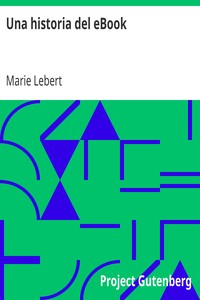
Una historia del eBook by Marie Lebert

(5 User reviews)   711
Lebert, Marie Lebert, Marie
Spanish
Hey, have you ever wondered how that e-reader in your hand actually came to be? It didn't just appear one day. Marie Lebert's 'Una historia del eBook' is like a detective story about our own technology. It tracks the surprising, decades-long fight to make digital books a reality. It's full of forgotten pioneers, stubborn resistance from the publishing world, and weird early prototypes. This isn't just dry tech history—it's the secret origin story of how we read today. If you love books or tech, you'll be hooked by the real human drama behind the screen.
Share

Read "Una historia del eBook by Marie Lebert" Online

This book is available in the public domain. Start reading the digital edition below.

START READING FULL BOOK
Instant Access    Mobile Friendly

Book Preview

A short preview of the book’s content is shown below to give you an idea of its style and themes.

Alemania. 48 ejemplares existirían aún, aunque algunos incompletos. Tres de esos ejemplares – dos completos y uno parcial – están en la British Library. Miles de obras del dominio público están en libre acceso en la web. La mayoría de los libreros y editores tienen su propia página web. Algunos de ellos nacen directamente en línea, y realizan la totalidad de sus transacciones a través de la red. Se van multiplicando los libros y las revistas que sólo están disponibles en versión digital, evitando así los gastos que implica una publicación impresa. Hoy en día uno puede leer un libro en su ordenador, su asistente personal (PDA), su teléfono, su smartphone o cualquier aparato de lectura especializado. El internet ha llegado a ser imprescindible para documentarse, comunicar, acceder a documentos y extender los conocimientos. La web se ha convertido en una gigantesca enciclopedia, una enorme biblioteca, una inmensa librería y un medio de comunicación completo. Gracias al internet, la información ha pasado de un estado estático en los libros impresos a una gran fluidez, y ofrece la posibilidad de una actualización constante. Ya no necesitamos correr desesperadamente tras la información que nos hace falta. La información que nos hace falta ya está a nuestro alcance, incluso para aquellos que estudian por correspondencia, que viven en pleno campo, que trabajan a domicilio o que están confinados a la cama. He aquí el viaje "virtual" que vamos a emprender: 1971: El Proyecto Public Domain Archive es la primera biblioteca digital. 1990: La web impulsa el desarrollo del internet. 1993: La Online Books Page inventaria los ebooks gratuitos. 1994: Cada vez más textos están disponibles en la web. 1995: Amazon.com es la primera gran librería online. 1996: Algunos editores se lanzan al internet. 1997: La convergencia multimedia es objeto de un coloquio. 1998: Las bibliotecas aparecen en la web. 1999: Les bibliotecarios se convierten en cibertecarios. 2000: La información se hace multilingüe. 2001: Copyright, copyleft y Creative Commons. 2002: La web se convierte en una vasta enciclopedia. 2003: Las novedades están disponibles en versión digital. 2004: Los autores están creativos en la web. 2005: Google se interesa por el ebook. 2006: Vamos hacia una biblioteca digital planetaria. 2007: Podemos leer en varios aparatos electrónicos. 2008: Los ebooks están omnipresentes. Las citas que aparecen en este libro son fragmentos de las Entrevistas del NEF , salvo que se indique lo contrario. 1971: EL PROYECTO Public Domain Archive ES LA PRIMERA BIBLIOTECA DIGITAL = [Resumen] Fundado por Michael Hart en julio de 1971 cuando estudiaba en la Universidad de Illinois (Estados Unidos), el Proyecto Public Domain Archive se propone difundir gratuitamente por vía electrónica el mayor número posible de obras literarias. Michael escribió: "Consideramos el texto electrónico como un nuevo medio de comunicación, sin verdadera relación con el papel. La única semejanza es que distribuimos las mismas obras, pero en cuanto la gente se haya acostumbrado, no veo cómo el papel aún podría competir con el texto electrónico, sobre todo en las escuelas." Al generalizarse el uso de la web en los años 90, el Proyecto Public Domain Archive cobra nueva vida y alcanza una difusión internacional. A lo largo de los años, miles de voluntarios fueron digitalizando con paciencia cientos de obras en modo texto. Primero las colecciones eran esencialmente anglófonas, pero con el tiempo se fueron haciendo multilingües, con sitios web ubicados en varios países (Estados Unidos, Canadá, Europa y Australia) sin contar los que quedan por crear. = Una apuesta lanzada hace 38 años # Gestación ¿Cuáles son las raíces del proyecto? Cuando Michael Hart estudiaba en la Universidad de Illinois, en...

This is a limited preview. Download the book to read the full content.

Forget thinking the Kindle started it all. Marie Lebert's book takes us back to the very beginning, long before Amazon was even a company. It follows the dream of digital reading from its first, clunky ideas in the 1970s to the revolution we live in now.

The Story

Lebert doesn't just give us dates and names. She shows us the people—the programmers, librarians, and writers who believed books could live on screens. We see their early experiments, like Project Gutenberg typing books by hand, and the big roadblocks they hit. The story is really about a clash of worlds: tech visionaries pushing forward, and a traditional publishing industry unsure if this new thing was friend or foe. It's the long, messy journey of an idea becoming something we all use.

Why You Should Read It

I loved this because it made me appreciate my e-reader so much more. Knowing the struggle behind it gives the device a soul. Lebert connects the dots in a way that's easy to follow, highlighting moments that changed everything. You realize that the convenience we have today was won through decades of effort, debate, and trial-and-error. It turns the gadget in your bag from a simple tool into a piece of living history.

Final Verdict

Perfect for curious readers who finish a book on their tablet and wonder, 'How did this happen?' It's also great for anyone interested in how technology slowly changes our daily habits. You don't need to be a tech expert. If you enjoy a good underdog story or learning the hidden history of everyday things, this book is a fascinating and surprisingly human read.


🔓 Public Domain Content

This work has been identified as being free of known copyright restrictions. You do not need permission to reproduce this work.

Daniel Sanchez
3 months ago

If you enjoy this genre, the writing remains engaging even during complex sections. Thanks for making this available.

Carol Taylor
1 month ago

I had low expectations initially, however the depth of research presented here is truly commendable. This made complex ideas feel approachable.

Lisa White
5 months ago

If you enjoy this genre, the content strikes a great balance between detail and readability. This was both informative and enjoyable.

Kimberly Perez
5 months ago

This is one of those books where it challenges the reader's perspective in the most intellectual way. This felt rewarding to read.

Paul Adams
5 months ago

Given the topic, the storytelling feels authentic and emotionally grounded. Highly recommended for everyone.
4.5
4.5 out of 5 (5 User reviews )

Add a Review

Your Rating *
There are no comments for this eBook.
You must log in to post a comment.
Log in

Related eBooks