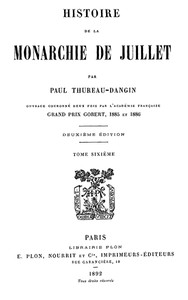
Histoire de la Monarchie de Juillet (Volume 6 / 7) by Paul Thureau-Dangin

(5 User reviews)   1213
Thureau-Dangin, Paul, 1837-1913 Thureau-Dangin, Paul, 1837-1913
French
Hey, so I just finished this deep dive into the final years of France's 'bourgeois monarchy' and wow — it reads like a political thriller where everyone knows the ending but can't stop it. Thureau-Dangin takes you inside the last act of King Louis-Philippe's reign, a government that tried so hard to be stable and reasonable it forgot how to survive. The book isn't about battles; it's about backroom deals, newspaper wars, and a growing sense that the whole system is just... tired. You watch politicians argue over budgets while the streets of Paris get restless. It's the story of how a kingdom that seemed secure in 1840 completely unraveled by 1848. If you like seeing how power actually works (and fails), this is your book.
Share

Read "Histoire de la Monarchie de Juillet (Volume 6 / 7) by Paul Thureau-Dangin" Online

This book is available in the public domain. Start reading the digital edition below.

START READING FULL BOOK
Instant Access    Mobile Friendly

Book Preview

A short preview of the book’s content is shown below to give you an idea of its style and themes.

Monarchie ou de République du 9 thermidor au 18 brumaire_; II. _L'Extrême Droite et les Royalistes sous la Restauration_; III. _Paris capitale sous la Révolution française_. _2e édition._ Un volume in-18. Prix 4 fr. » =Le Parti libéral sous la Restauration=. _2e édition._ Un vol. in-18. Prix 4 fr. » =L'Église et l'État sous la Monarchie de Juillet=. Un vol. in-18. Prix 4 fr. » =Histoire de la Monarchie de Juillet.= Tomes I, II, III, IV et V, _2e édition_. Prix de chaque vol. in-8º 8 fr. » (_Couronné deux fois par l'Académie française, GRAND PRIX GOBERT, 1885 et 1886._) PARIS.--TYPOGRAPHIE DE E. PLON, NOURRIT ET Cie, RUE GARANCIÈRE, 8. HISTOIRE DE LA MONARCHIE DE JUILLET LIVRE VI L'APOGÉE DU MINISTÈRE CONSERVATEUR (DE LA FIN DE 1845 AU COMMENCEMENT DE 1847) CHAPITRE PREMIER LES ÉLECTIONS DE 1846. (Fin de 1845-août 1846.) I. Bonne situation du ministère à la fin de 1845. M. Thiers unit le centre gauche à la gauche. Le _National_ et la _Réforme_.--II. L'opposition dans la session de 1846. Débats sur les affaires du Texas et de la Plata.--III. L'opposition crie à la corruption. Défense du ministère. Qu'y avait-il de fondé dans ce grief?--IV. La campagne contre le pouvoir personnel. Débat sur ce sujet entre M. Thiers et M. Guizot. La majorité fidèle au cabinet.--V. Tranquillité générale. Attentat de Lecomte. Évasion de Louis Bonaparte.--VI. Dissolution de la Chambre. Polémiques électorales. Attentat de Henri. Les résultats du scrutin. Ce qu'on en pense dans le gouvernement. I Le ministère durait depuis cinq ans. Plusieurs fois l'opposition s'était crue sur le point d'en avoir raison: toujours elle avait échoué. Sa dernière déception n'avait pas été la moins complète ni la moins mortifiante. On sait comment M. Guizot, un instant ébranlé, au début de la session de 1845, par le débat sur l'indemnité Pritchard, s'était bientôt après raffermi, et comment même, quelques mois plus tard, grâce à l'heureuse issue des négociations engagées à Londres sur le droit de visite et à Rome sur l'affaire des Jésuites, il était sorti de cette session plus solide qu'il ne l'avait jamais été. À la fin de 1845, on se trouvait encore sous l'impression de ce double succès. Aucune grosse difficulté n'embarrassait la politique du cabinet, soit en France, soit en Europe; l'horizon, naguère si chargé, s'était partout éclairci. Tout au plus discernait-on un point noir du côté de l'Algérie, où l'indomptable Abd-el-Kader venait de reprendre les armes; mais cet accident local mettait surtout en cause la responsabilité du maréchal Bugeaud. Le ministère paraissait impossible à renverser, tant du moins que subsisterait la Chambre actuelle. Cette conviction, universellement répandue, produisait son effet sur les députés. La victoire attire, la défaite désagrège. Les flottants se détachaient de l'opposition et rentraient dans la majorité. Le gouvernement ne cachait pas, d'ailleurs, son intention de dissoudre la Chambre après la session de 1846; pour tous ceux qui ne se sentaient pas sûrs de leurs collèges, il n'était que temps de se remettre bien avec les ministres qui feraient sûrement les élections. Le changement qui s'opéra à ce moment dans la situation du centre gauche ne contribua pas peu à raffermir la majorité. Jusqu'alors, ce groupe avait gardé une position moyenne, intermédiaire, qui lui permettait de tendre la main, suivant les circonstances, soit à la gauche, soit au centre. Son chef, M. Thiers, avait paru, plus que personne, soucieux des avantages de cette position. Mais, à la fin de 1845, n'espérant plus rien du centre, il annonça l'intention de réunir le centre gauche et la gauche, pour en faire une seule armée dont il se flattait d'avoir le commandement. Après discussion...

This is a limited preview. Download the book to read the full content.

Paul Thureau-Dangin's sixth volume covers the years 1840 to 1848, the sunset years of France's July Monarchy. King Louis-Philippe, the 'Citizen King,' is firmly on the throne, but his government is running on fumes. The book follows the political maneuvering of ministers like Guizot, who champion a policy of peace and prosperity at all costs, and the rising opposition from both left and right who see the regime as stale and out of touch.

The Story

This isn't a novel with a single hero. The 'story' is the slow-motion collapse of a political idea. Thureau-Dangin shows us the parliamentary squabbles, the economic debates, and the intellectual ferment happening in newspapers and salons. We see the government increasingly rely on corruption to maintain its majority, while public excitement gets funneled into foreign policy dramas like the 'Eastern Question.' All the while, beneath the surface of orderly debate, a profound boredom and frustration with the whole system is building in the country, especially in Paris. The narrative marches, with a sense of inevitable tragedy, toward the revolutionary spark of 1848.

Why You Should Read It

Thureau-Dangin writes history with a novelist's eye for personality and irony. He makes you feel the strange atmosphere of the time—a period of material progress and deep political stagnation. You get why the king and his ministers thought they were successful, and you also get why everyone else was so fed up. It's a masterclass in how regimes fall apart from the inside, long before the barricades go up.

Final Verdict

Perfect for history buffs who prefer analysis over battle descriptions, and for anyone fascinated by the mechanics of political failure. It’s dense, but rewarding. You won't get cavalry charges, but you will get a gripping autopsy of a society that chose comfort over vision, and paid the price. If you've ever wondered how a stable government can suddenly not exist anymore, this book has answers.


📢 Copyright Free

Legal analysis indicates this work is in the public domain. It serves as a testament to our shared literary heritage.

Paul Sanchez
3 months ago

What caught my attention immediately was that the organization of topics is intuitive and reader-friendly. Thanks for making this available.

Mark Davis
3 months ago

I’ve read many books on this subject, and it provides a comprehensive overview that is perfect for students and experts alike. Thanks for making this available.

Brian Sanchez
2 weeks ago

Surprisingly enough, the clarity of the writing makes this accessible to a wide audience. A perfect companion for a quiet weekend.

Lisa Sanchez
2 months ago

If you enjoy this genre, the writing style is poetic but not overly flowery. Simply brilliant.

Oliver Wright
3 months ago

I stumbled upon this by accident and the pacing is just right, keeping you engaged from start to finish. I finished this feeling genuinely satisfied.

5
5 out of 5 (5 User reviews )

Add a Review

Your Rating *
There are no comments for this eBook.
You must log in to post a comment.
Log in

Related eBooks