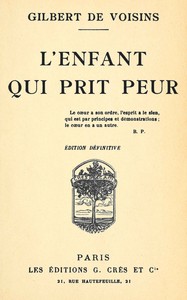
L'enfant qui prit peur by Auguste Gilbert de Voisins

(4 User reviews)   390
Gilbert de Voisins, Auguste, 1877-1939 Gilbert de Voisins, Auguste, 1877-1939
French
Hey, have you ever read a ghost story that's more about the ghosts we carry inside than the ones that go bump in the night? That's 'L'enfant qui prit peur' (The Child Who Was Afraid). It's this haunting, early 20th-century French novel about a boy whose world is shattered by a single, terrifying event. The book isn't about a monster under the bed; it's about how that first, real childhood fear can twist and grow, shaping a person's entire life. It's short, beautifully written, and will stick with you long after you finish the last page. If you like psychological stories that explore the shadows of memory, you need to pick this up.
Share

Read "L'enfant qui prit peur by Auguste Gilbert de Voisins" Online

This book is available in the public domain. Start reading the digital edition below.

START READING FULL BOOK
Instant Access    Mobile Friendly

Book Preview

A short preview of the book’s content is shown below to give you an idea of its style and themes.

bougerait plus; il serait sage. Pour mieux rêver, il ferma les yeux. Ce matin-là, le docteur Périer avait dit: «Si Jacquot est bien sage, il pourra sortir dans peu de jours. Nous nous sommes inquiétés à tort.» Et Maman avait répondu: «Dieu soit loué!» Ensuite, ils s’étaient mis à parler de la maladie dont souffrait Jacquot, de cette maladie qui portait un si joli nom: la roséole. Jacquot eût voulu deviner quel rapport son ami, le grand rosier pourpre qui fleurissait au fond du jardin, pouvait avoir avec elle. La roséole... la roséole... joli mot! Tout de même, quel ennui! Et le beau soleil l’appelait, l’invitait à sortir, quand il devait rester au lit sans s’être jamais senti très malade. Il n’avait plus causé depuis quinze jours avec le vieux Pierre qui lui racontait tant d’histoires! toutes si belles! il n’avait plus visité les coins innombrables du jardin: grottes, cachettes, lieux secrets, connus de lui seul et de Lucienne à qui il les avait révélés, en s’assurant de sa discrétion par des serments terribles. Et surtout, il n’avait plus vu Lucienne, il ne l’avait plus entendu rire sous son grand chapeau rose. Comment pouvait-elle jouer sans Jacquot? Seule, ne s’ennuyait-elle pas? Assurément, mais «la roséole est contagieuse». Enfin, tout cela finirait bientôt. Dans quelques jours, il pourrait sortir. Ce serait, de nouveau, les passionnantes parties de cache-cache avec Lucienne au chapeau rose, avec Alice aux cheveux pâles tirés en arrière et que l’on taquinait en attachant un grelot au ruban de sa tresse, avec Henri, encore bien petit, (huit ans seulement), avec Paul, qui devait, au début d’octobre, aller à Paris pour suivre dans un lycée la classe de cinquième. Jacquot s’imaginait déjà les cris et les disputes et les faux pas sur les racines des pins et les belles glissades où les aiguilles piquent les mollets si fort. Oh! que ce serait donc beau! Puis le soir viendrait: Alice et Paul s’en iraient le long du petit chemin des douaniers avec Mlle Stéphanie, Henri serait emporté dans une charrette à deux roues par le cocher de ses parents, et Lucienne n’aurait qu’à traverser la route pour rentrer chez elle, mais, auparavant, Jacquot cueillerait au grand rosier une rose pourpre et la lui donnerait, et Lucienne partirait en souriant, sa rose à la main. La journée eût semblé incomplète si Jacquot n’avait offert à Lucienne une rose pourpre, tant qu’il restait des roses au rosier. Maintenant, il était seul dans le jardin. Le soleil baissait, lançant sous les plus de longs rayons aveuglants, pleins de poussière rouge. C’était l’heure où Pierre, le vieux pêcheur, passant dans le petit sentier d’en bas, s’arrêtait pour dire toujours la même phrase: «Eh! bonsoir, monsieur Jacquot! c’est pas encore cette nuit que vous venez à la pêche dans ma barque?» Des bêtises, quoi! Enfin Jacquot, après avoir causé quelques instants avec le vieux, remontait jusqu’à la maison, entrait dans l’antichambre par la porte vitrée, un peu las, un peu courbatu, un peu étourdi par toutes ces belles courses et, pour se laver les mains, gagnait sa chambre d’un pas traînard. La journée était finie, car il n’y avait ensuite que le repas du soir et cela n’offrait aucune espèce d’intérêt. Oh! qu’il désirait reprendre cette vie! Jacquot fermait les yeux pour mieux goûter le précieux souvenir. La grosse mouche volait de nouveau dans le rayon de soleil que fonçait l’heure tardive; l’anémone repliait lentement ses pétales; au dehors, la branche de pin se découpait plus noire encore sur le ciel devenu rouge, et le bruit de la mer paraissait s’assourdir. Mais Jacquot ne prêtait...

This is a limited preview. Download the book to read the full content.

I stumbled upon this little-known gem and was completely pulled into its quiet, unsettling world. Published in 1921, it feels both of its time and strangely timeless.

The Story

The story follows a young boy living a sheltered life in the French countryside. His world is orderly and safe, until one evening he witnesses something profoundly disturbing—an event the book deliberately keeps vague, making it all the more powerful. This moment of pure terror becomes a crack in his reality. We watch as this fear, instead of fading, takes root. It colors everything: his relationships, his perceptions of home and family, and his own budding sense of self. The narrative follows him from childhood into young adulthood, tracing how that initial shock echoes through his life.

Why You Should Read It

What got me wasn't a plot full of action, but the book's deep empathy. Gilbert de Voisins writes about childhood trauma with a sensitivity that feels ahead of its time. He shows how a fragile mind processes horror, not with logic, but with distorted memories and heightened senses. The atmosphere is thick with unease—you feel the boy's confusion and dread right alongside him. It’s less about what *happened* and more about the lasting damage of the feeling itself.

Final Verdict

This is a book for the thoughtful reader. Perfect for anyone who loves character-driven stories, early psychological fiction, or classic European literature that prioritizes mood over plot. If you're a fan of the introspective unease in Henry James's 'The Turn of the Screw' or the emotional precision of Colette, you'll find a kindred spirit here. It's a slow, penetrating look at the origins of fear, and a reminder of how long childhood shadows can be.


🔖 Community Domain

This digital edition is based on a public domain text. It is available for public use and education.

Daniel Wright
2 months ago

While comparing similar resources, the examples used throughout the text are practical and relevant. I'm sending the link to all my friends.

Donna Torres
3 months ago

After hearing about this multiple times, the atmosphere created by the descriptive language is totally immersive. Simply brilliant.

Steven Lewis
2 months ago

From a reader’s standpoint, the technical accuracy of the content is spot on. I couldn't put it down until the very end.

Linda Martinez
3 weeks ago

As someone who reads a lot, the balance between theory and practice is exceptionally well done. An excellent read overall.


3.5
3.5 out of 5 (4 User reviews )

Add a Review

Your Rating *
There are no comments for this eBook.
You must log in to post a comment.
Log in

Related eBooks