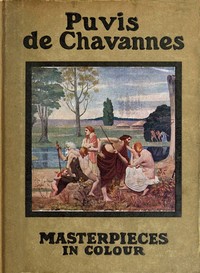
Puvis de Chavannes by François Crastre

(4 User reviews)   410
Crastre, François Crastre, François
English
Hey, I just finished this fascinating deep-dive into Pierre Puvis de Chavannes, an artist everyone sort of knows but no one really *knows*. François Crastre’s book isn’t just a biography—it’s a detective story about an artistic ghost. Puvis was a giant in his day, painting those dreamy, timeless murals you’ve probably seen in museums. But then, modern art exploded, and he was almost written out of history. Crastre chases the mystery: how did this painter, so beloved and influential, vanish from the conversation? If you’ve ever wondered how artistic reputations are made and broken, this is your book. It’s a quiet quest to rescue a genius from the shadows.
Share

Read "Puvis de Chavannes by François Crastre" Online

This book is available in the public domain. Start reading the digital edition below.

START READING FULL BOOK
Instant Access    Mobile Friendly

Book Preview

A short preview of the book’s content is shown below to give you an idea of its style and themes.

Millet live in a state bordering upon penury and die in destitution. Renown seeks them out later, much too late, and tardy laurels flower only upon their tomb. Puvis de Chavannes for a long time fared scarcely better than these illustrious mendicants of art. He experienced the bitter pangs of injustice, the hostility of ignorance, the discouragement of finding himself misunderstood. If he was spared the extreme distress of Millet, it was solely because he was the more fortunate of the two in possessing a small private income. But nothing can crush the spirit of the born artist; neither contempt nor ridicule can hold him back. Puvis de Chavannes was endowed with a valiant and a tenacious spirit. Entrenched within the loftiness of his artistic ideal, as within a tower of bronze, he was steadfastly scornful of critics, affecting not to hear them; and never would he consent to disarm them by concessions that in his eyes would have seemed dishonourable. Yet this rare probity brought its own reward. The great painter attained the joy of seeing himself at last understood, and not only understood but admired during his life-time. He must even have derived an ironic satisfaction from counting among his warmest adherents certain ones who had formerly been conspicuous as his most violent detractors. [Illustration: PLATE II.--THE PIETY OF SAINT GENEVIEVE (In the Panthéon, Paris) In this composition, exceptionally fine in feeling, Puvis de Chavannes shows how much importance he attached to landscape, which was the natural setting of his paintings, and which he treated with as much care as his personages themselves.] Today the glory of Puvis de Chavannes shines forth in uncontested splendour. No one dreams of comparing him with any of his contemporaries, because his art reveals no kinship with that of any one of them. He is recognized as the successor and the equal of the great fresco painters of the Italian Renaissance. Even to these he owes nothing, having borrowed nothing from them. But he shares with them his passionate love of truth, his nobility of inspiration and sincerity of execution. There are no longer insinuating and derisory shakings of the head in the presence of his works. One must be devoid of soul in order not to sense their beauty. Even the ignorant, in the presence of this form of art which they do not understand, gaze upon it with respectful wonder, as upon something very great, the content of which they fail to make out, although they realize its power from the inner emotion they experience. "My dear boy," wrote Puvis de Chavannes to one of his pupils, "direct your soul compass-like, towards some work of beauty; that is the way to achieve it in its entirety." It is because he directed his own soul, compass-like, only towards works of a noble and pure beauty, surrendering himself with all the ardour of his impetuous and vibrant nature, that Puvis de Chavannes has taken his place as one of the noblest figures, not only in contemporary painting, but also in the painting of all times. THE FIRST YEARS Pierre Puvis de Chavannes was born at Lyons, December 14, 1824. His parents were in affluent circumstances and were connected with one of the old Burgundian families. His father pursued the vocation of chief engineer of mines, at Lyons. In the registry of births, in which the new-born child was entered, the father is designated simply by the name of Marie-Julien-César Puvis. The honourable title of "de Chavannes," claimed later and with good right by the family, was confirmed to him by a decree...

This is a limited preview. Download the book to read the full content.

François Crastre’s book on Puvis de Chavannes is less a standard art history text and more of a rescue mission. It introduces us to Pierre Puvis de Chavannes, the 19th-century French painter famous for his large, serene murals in public buildings like the Panthéon. His work was everywhere, setting the visual tone for an era. But then, the story takes a turn.

The Story

Crastre walks us through Puvis’s life and major works, showing how he became a national treasure. But the real heart of the book is what happened next. As bold, new movements like Impressionism and Cubism took center stage, Puvis’s classical, allegorical style fell out of fashion. Critics began to dismiss him as old-fashioned, and his massive influence on artists like Seurat, Gauguin, and even Picasso was quietly forgotten. Crastre tracks this disappearance, asking not just what Puvis painted, but why we stopped looking.

Why You Should Read It

This book changed how I see museums. It’s a powerful reminder that art history isn’t fixed; it’s a story we keep rewriting. Crastre writes with a clear passion for his subject, making you see the beauty and innovation in Puvis’s muted colors and simplified forms. You start to spot his ghost in unexpected places, in the work of the very modernists who supposedly replaced him. It’s about the fragility of legacy and makes you question who else might be missing from the standard narrative.

Final Verdict

Perfect for art lovers who enjoy a good historical mystery, or anyone curious about the forces that decide which artists we remember. You don’t need a PhD to get into it—Crastre’s writing is clear and driven by genuine curiosity. It’s for the reader who looks at a grand old painting and wonders, ‘What’s the real story here?’


✅ Legal Disclaimer

The copyright for this book has expired, making it public property. Knowledge should be free and accessible.

Jackson Jackson
5 months ago

This quickly became one of those books where the progression of ideas feels natural and coherent. An excellent read overall.

Noah Lee
6 days ago

As someone who reads a lot, the tone remains consistent and professional throughout. An impressive piece of work.

Elijah Smith
2 months ago

Honestly, the author anticipates common questions and addresses them well. An unexpectedly enjoyable experience.

Mason King
2 months ago

Tihs came highly recommended and the organization of topics is intuitive and reader-friendly. Worth every second of your time.

4
4 out of 5 (4 User reviews )

Add a Review

Your Rating *
There are no comments for this eBook.
You must log in to post a comment.
Log in

Related eBooks